Key Takeaways
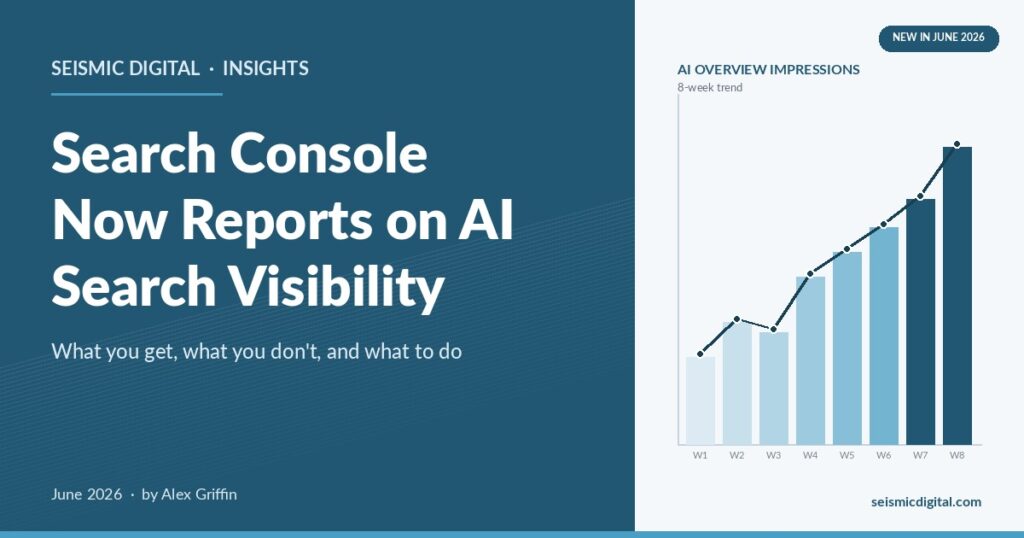
- Search Console now reports impressions, pages, countries, devices, and date trends for AI Overviews, AI Mode, and AI features in Discover.
- Click data is not part of the new report, so impressions remain the primary measure of AI visibility for now.
- A new opt-out toggle blocks generative AI features without affecting core Search rankings, taking effect on June 17, 2026.
- Access starts with a small group of UK site owners under CMA rules, with global expansion to follow.
On June 3, 2026, Google added a Search Generative AI performance report to Search Console. Impressions data for AI Overviews, AI Mode, and AI features in Discover now sits next to your standard Search reports. A second feature, a toggle to opt your site out of generative AI features, shipped alongside the report. Both are rolling out first to a small group of UK site owners, with global expansion to follow. This post walks through what the new tools show, what they leave out, and how SEO teams should respond.
What Google Released on June 3, 2026
Google released two Search Console updates: a Search Generative AI performance report covering AI Overviews, AI Mode, and AI features in Discover, plus a control letting a site owner opt out of generative AI features. Both updates are rolling out first to a small group of UK site owners.
Google’s official announcement landed on June 3. The first new piece is a Search Generative AI performance report inside Search Console, with separate views for Search and for Discover. The second is a Search Console toggle for opting out of generative AI features. Search Engine Roundtable has a detailed walkthrough with screenshots from early UK testers.
The UK-first rollout is required by a UK Competition and Markets Authority ruling, covered in more detail below. Global expansion has no firm date, only stated intent.
AI Search Vocabulary, Defined
AI Overviews are Google’s AI-generated summary panels at the top of certain Search results. AI Mode is Google’s conversational AI search experience inside Google Search. The Search Generative AI performance report is the new Search Console report covering impressions inside both surfaces.
- AI Overviews: Google’s AI-generated summary at the top of select Search results, citing the web pages used to ground the answer.
- AI Mode: Google’s conversational AI search interface inside Google Search, launched in 2025.
- Generative AI features in Discover: AI-generated previews and recommendations inside Google Discover feeds.
- Search Generative AI performance report: A new Search Console report showing impressions for AI Overviews, AI Mode, and AI features in Discover.
- Opt-out toggle: A Search Console control blocking a site’s content from appearing in generative AI features without changing the site’s standard Search ranking.
What the AI Performance Report Shows
The Search Generative AI performance report shows impressions, pages, countries, devices, and date trends for AI Overviews, AI Mode, and AI features in Discover. Data starts on May 18, 2026 and is split into two reports, one for Search and one for Discover.
Five dimensions are included in the new report:
- Impressions: how often URLs from your site appeared in generative AI features
- Pages: which URLs appeared inside AI features
- Countries: visibility broken out by country
- Devices: device breakdown for the Search version of the report
- Dates: hourly, daily, weekly, and monthly granularity
The data lives inside Search Console with the same access roles, export tools, and API surface most SEO teams already use. Two separate reports are available:
| Report | What It Covers | Devices Dimension |
|---|---|---|
| Search AI report | AI Overviews and AI Mode inside Google Search | Yes |
| Discover AI report | Generative AI features inside Google Discover | No |
What Is Missing From the AI Performance Report
The Search Console AI performance report shows impressions only. Click data, conversion attribution, and query-level detail are not included at launch.
Google addressed the gap directly in the announcement, telling site owners the company is continuing to work with publishers on what insights will be most helpful and noting more metrics will arrive over time.
For now, AI search visibility is a top-of-funnel metric inside Search Console. Conversion attribution from AI Overviews still requires server logs, AI referrer tracking in GA4, or specialty tools monitoring non-Google engines. The new report adds a first-party view of impressions, not a complete funnel.
How the Opt-Out Toggle Works
The Search Console opt-out toggle blocks a site’s content from appearing in AI Overviews, AI Mode, and AI features in Discover. The toggle does not affect ranking in standard Search results and takes effect on June 17, 2026 for users in the early rollout.
Two important details stand out from Google’s announcement:
First, opting out removes both traffic and impressions from AI features. A site opting out will no longer appear in or receive traffic from generative AI search experiences.
Second, opting out does not affect ranking in standard Search results. Google confirmed the toggle is not used as a ranking signal for search results outside of generative AI features.
The control covers AI Overviews, AI Mode, and AI features in Discover. The Search Console interface lets early-access users configure a preference before the change takes effect. Google has said the company will start applying the control on June 17, 2026 for users in the early rollout.
Opt-Out Toggle vs. robots.txt vs. Google-Extended
Robots.txt blocks crawler access. Google-Extended blocks AI model training. The new Search Console opt-out toggle blocks appearance in generative AI features at serving time. The three controls overlap but solve different problems.
- Robots.txt: A file at the root of a site telling crawlers which paths to access.
- Google-Extended: A user agent control determining whether Google uses a site’s content to train Gemini and related AI models.
- Search Console opt-out toggle: A Search Console setting controlling whether a site appears in generative AI features at serving time.
| Control | What It Blocks | What Stays Untouched | When to Use |
|---|---|---|---|
| robots.txt | Crawler access to listed paths | Already-indexed pages, AI Overview eligibility for unblocked pages | Block bots from hitting specific pages or directories |
| Google-Extended | Use of content for training Gemini and related models | Search ranking, AI Overview eligibility, serving-time use | Keep content out of AI training without losing AI visibility |
| Opt-out toggle | Appearance in AI Overviews, AI Mode, AI in Discover | Standard Search ranking and indexing | Remove a site from generative AI features without affecting Search |
Some brands will use one of these controls, some will use several, and most will use none. A publisher worried about training-time use will keep Google-Extended in place. A site owner worried about losing AI traffic but comfortable with training-time use will leave both alone. The Search Console toggle is the most surgical of the three.
Why Google Rolled the Update Out in the UK First
The UK rollout is required by a UK Competition and Markets Authority (CMA) ruling giving publishers control over AI use of their content. Google has nine months under the ruling to fully roll the controls out across the UK, with global expansion to follow on no fixed timeline.
The CMA decision requires Google to give UK publishers control over AI use of their content. In plain terms, Google must allow publishers to opt out of having their content used for fine-tuning AI models, giving publishers confidence in full control over the range of AI use-cases.
Google has nine months under the UK ruling to fully roll the controls out to all UK site owners. Global expansion has no published timeline, though the announcement language suggests other regions will follow. For US and Canadian clients, planning should treat second-half 2026 as the realistic window for access.
How the Report Compares to Other AI Visibility Tools
Search Console is the second major webmaster tool with a generative AI report. Bing Webmaster Tools shipped a similar AI performance report earlier in 2026. Third-party platforms still fill gaps in citation tracking across non-Google engines and in conversion attribution.
| Tool | What It Tracks | First-Party Source |
|---|---|---|
| Search Console AI performance report | Impressions for AI Overviews, AI Mode, and AI features in Discover | |
| Bing Webmaster Tools AI report | Impressions inside Bing AI features | Microsoft |
| Profound, Otterly, and similar trackers | Citations and mentions across ChatGPT, Perplexity, Gemini | Third-party |
| GA4 referrer reports plus server logs | Conversion attribution from AI referrers | Your own data |
For background on how AI search optimization fits into broader SEO strategy, see our post on Google’s May 2026 AI Optimization Guide and the foundational piece on AI’s impact on search.
What to Do This Quarter
For most brands, baseline AI impressions once access lands and leave the opt-out toggle alone. Opting out removes free AI distribution. The right path leans into AI visibility instead of blocking the surface.
Do this:
- Check Search Console weekly for access. The new reports appear in the left navigation under Performance once your property is in the rollout group.
- Baseline AI impressions for priority pages once data is available. Compare against the standard Search impressions report for the same URLs to size AI visibility as a share of total search exposure.
- Pair the Search Console report with non-Google AI visibility tracking for ChatGPT, Perplexity, and Gemini.
- Audit robots.txt for AI crawler access. GPTBot, ClaudeBot, PerplexityBot, Google-Extended, and OAI-SearchBot should be allowed unless a specific reason blocks them.
For brands considering an opt-out, a quick risk review with stakeholders is the right next step. For brands aiming to lean into AI search visibility, the playbook we walked through in the May 2026 AI Optimization Guide post still applies. Primary-source content, clean technical structure, and earned authority remain the levers.
The Bottom Line
The Search Console AI performance report closes a real measurement gap. The opt-out toggle is a defensive feature most brands should leave alone. Both updates point in the same direction: AI search is now a first-class surface inside Google’s webmaster tooling.
Click data and broader metrics will follow on Google’s timeline. The brands worth watching are the publishers who pushed the CMA ruling forward. Their next moves will tell the industry whether opting out of AI features costs more than the AI traffic the same brands give up.
Want help planning your AI search measurement and visibility strategy against the new tools? Reach out to our team, or browse our services.